Article: What Is Red Light Therapy

What Is Red Light Therapy
�
What Is Red Light Therapy? A Complete Beginner's Guide
If you've scrolled through skincare lately, you've seen the glowing masks — faces lit up in red, calm and futuristic. Red light therapy has moved from dermatology offices and spas into living rooms, and for good reason: it's one of the few at-home skincare approaches with real science behind it. But the marketing noise makes it hard to know what's true.
This guide cuts through that. We'll explain what red light therapy actually is, how it works, what the different colors of light do, what it's genuinely cleared to treat, and how to use it safely at home — without the hype.
What Is Red Light Therapy?
Red light therapy is a skincare and wellness method that uses specific wavelengths of visible red and near-infrared light to support the skin. You may also see it called LED light therapy, low-level light therapy (LLLT), or photobiomodulation — they all refer to the same core idea: exposing skin to carefully chosen wavelengths of light to encourage a beneficial response in skin cells.
Unlike the sun or a tanning bed, red light therapy devices don't use ultraviolet (UV) light. There's no tanning and no burning involved. Instead, they deliver gentle, low-energy light in the red and near-infrared part of the spectrum — the wavelengths research has focused on most for skin.
It started in clinical and professional settings, where dermatologists and estheticians used larger panels and handpieces. Today, well-made at-home LED masks bring a version of that experience into a 10-minute routine you can do on your couch.
How Does Red Light Therapy Work?
Here's the simple version. Your skin cells contain mitochondria — often described as the cell's "power plants." Research into photobiomodulation suggests that certain wavelengths of red and near-infrared light are absorbed by components inside these mitochondria, which may support the cell's natural energy production and activity.
When skin cells are working efficiently, they're better equipped to do the everyday jobs that keep skin looking healthy — like maintaining the structures that give skin its firmness and smooth appearance. That's the mechanism behind why red light is studied so heavily for the appearance of fine lines and skin texture.
The key word is wavelength. Light is measured in nanometers (nm), and different nanometer ranges behave differently in the skin — some sit closer to the surface, others reach a little deeper. This is why a quality device uses specific, deliberate wavelengths rather than just "a red light."
The Different LED Wavelengths and What They Do
Most modern LED masks combine more than one color of light, because each wavelength is associated with a different focus. Here's a beginner-friendly breakdown:
Red light (around 630–660nm). The most studied wavelength for skin appearance. It's associated with supporting a smoother, firmer-looking complexion and is the workhorse of most masks.
Near-infrared light (around 800–850nm). Invisible to the eye and able to reach a little deeper than red. Often paired with red light to broaden the treatment.
Blue light (around 415nm). Sits at the surface and is associated with targeting the bacteria involved in breakouts. This is the wavelength most connected to acne-prone skin.
Yellow/amber light (around 590nm). A gentler surface wavelength sometimes included to support an even, radiant-looking tone.
A mask that includes red, near-infrared, blue, and yellow gives you the most flexibility — supporting both the appearance of aging and clarity concerns in one device. (Want to know which wavelengths matter most when shopping? See our buyer's guide: [[How to Choose an LED Face Mask]].)
What Red Light Therapy Is Cleared to Treat
This is where it's important to separate marketing from fact. In the United States, an LED mask that makes a medical claim is regulated by the FDA, and it must hold FDA clearance (a 510(k)) to make that claim legally.
The Luxycara mask is FDA-cleared (K250830) for two specific uses:
Treatment of full-face wrinkles (using red, yellow, and red+infrared light), and
Treatment of mild-to-moderate inflammatory acne (using blue and combined light modes).
Those are the claims backed by the clearance — and the ones we'll stand behind. Beyond that, you'll see red light therapy discussed in many other contexts across the wellness world, but for skincare specifically, wrinkles and mild-to-moderate inflammatory acne are the substantiated, cleared uses. Be cautious of any at-home mask promising to "erase" wrinkles, "cure" acne, or fix concerns like scarring or pigmentation — those go beyond what these devices are cleared to do.
One quick but important note: look for the words "FDA-cleared," not "FDA-approved." For this category of device, "cleared" is the correct and honest term. ("Approved" is a different regulatory pathway and a red flag when you see it on a face mask — more on spotting trustworthy brands in [[FDA-Cleared vs FDA-Approved LED Masks]].)
At-Home Masks vs In-Office Treatments
Professional, in-office light treatments use higher-powered equipment and are administered by trained providers, often as part of a broader treatment plan. They can be powerful — and priced accordingly, usually per session.
At-home LED masks take a different approach: lower intensity, but designed for consistency. The trade-off is that results come from a gentle dose repeated regularly over weeks, rather than a strong dose a few times a year. For most people building a long-term routine, that consistency is exactly the point — and it's far kinder to your budget.
How to Use an LED Face Mask
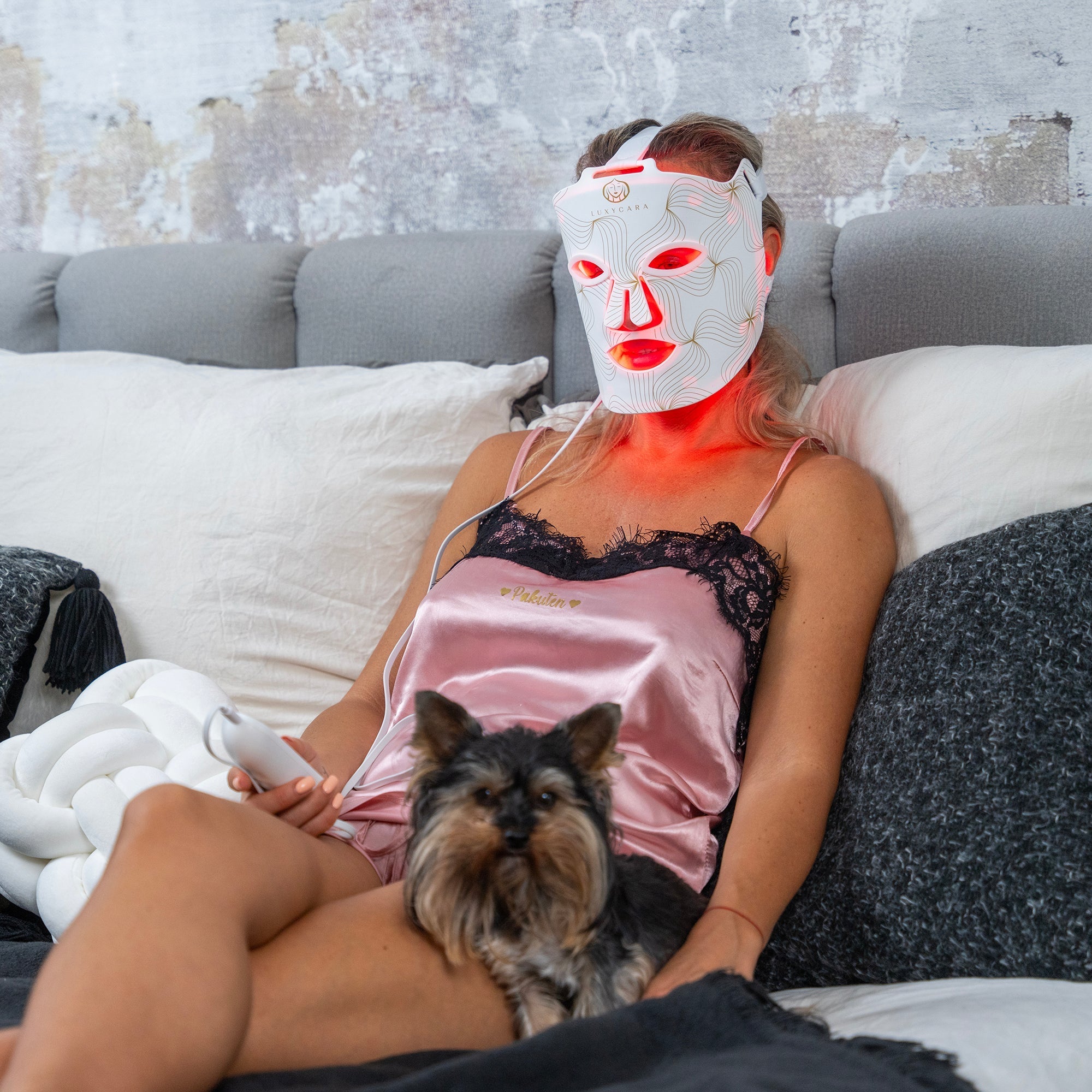
The beauty of an LED mask is its simplicity. The general routine looks like this:
Start with clean, dry skin. Light works best on a bare surface, so cleanse first and skip heavy products underneath.
Put on the mask and relax for the recommended session length (often around 10 minutes).
Use it consistently — most routines call for several sessions per week. Regularity matters more than any single session.
Follow with your usual serum and moisturizer to lock in your routine.
That's it — a low-effort habit that fits into a wind-down ritual. For a full walkthrough including timing, frequency, and where it fits in your routine, see [[How to Use an LED Face Mask: Step-by-Step]].
Is Red Light Therapy Safe?
For healthy adults, at-home LED masks are designed to be gentle and are sold over-the-counter. A few sensible points for beginners:
Protect your eyes. Follow the device's guidance and avoid staring directly into the lights. Many people simply keep their eyes closed during a session.
No UV, no tanning. Quality LED masks don't emit UV light.
Check the contraindications. If you're pregnant, taking light-sensitizing medication, or have a specific skin condition, check with a healthcare professional first. Always read the instructions for use that come with your device.
As with anything in skincare, start gradually and pay attention to how your skin responds.
How Long Until You See Results?
Patience is part of the process. Red light therapy isn't an overnight switch — it's a "show up consistently" kind of treatment. Because it works gradually, the people who are happiest with their results are the ones who make it a regular habit over several weeks rather than expecting an instant change.
Set the expectation up front: think in terms of weeks of steady use, not days. A simple way to stay motivated is to take a photo at the start and track your progress over time, so you can actually see the gradual change instead of trying to remember it.
What to Look for in a Quality LED Mask
Not all masks are equal. When you're comparing options, the things that genuinely matter:
FDA clearance for the claims being made (and the honest use of "cleared," not "approved").
The wavelengths included — and whether they match the concerns you care about.
Build and fit — a mask that contours comfortably to your face, in skin-safe materials.
A realistic, transparent brand that doesn't over-promise.
We go deep on this in the full buyer's guide: [[How to Choose an LED Face Mask: Buyer's Checklist]].
The Bottom Line
Red light therapy is one of the rare skincare trends with real substance behind it — a gentle, non-invasive way to support the look of your skin from home. The science centers on specific wavelengths of light encouraging healthy skin-cell activity, and for at-home masks, the cleared, substantiated focus is the appearance of wrinkles and mild-to-moderate inflammatory acne. Approach it with realistic expectations and consistency, and it becomes a genuinely worthwhile ritual.
The Luxycara LED mask is FDA-cleared (K250830), built with four therapeutic wavelengths in skin-safe medical-grade silicone, and designed for exactly this kind of calm, consistent routine.
See the difference. Don't just hope for it. [[Shop the Luxycara mask →]]
Frequently Asked Questions
Is red light therapy the same as an LED face mask?
An LED face mask is one way to deliver red light therapy at home. "Red light therapy" is the method; the mask is the device.
Does red light therapy use UV light?
No. Quality LED masks use visible red, near-infrared, and other wavelengths — not UV — so there's no tanning or burning involved.
How often should I use an LED mask?
Most routines call for several short sessions per week. Consistency over time matters more than the length of any single session — always follow your device's instructions.
Is it FDA-approved?
Look for "FDA-cleared," not "approved" — that's the correct term for this device category. The Luxycara mask is FDA-cleared (K250830) for treating full-face wrinkles and mild-to-moderate inflammatory acne.
When will I see results?
Think in weeks of regular use, not days. Taking a starting photo and tracking over time is the easiest way to notice the gradual change.